
How to Plan a 10-Day Italy Itinerary That Actually Works
Planning a 10-day Italy itinerary requires choosing 2-3 destinations maximum, factoring in 1-2 travel days, and balancing iconic sights with authentic experiences. The best itineraries focus on depth over breadth — spending 3-4 nights per city rather than rushing through five destinations in ten days.
Choose Your Italy Focus: Regions and Themes
The first decision shapes everything else: what kind of Italy experience do you want?
North vs. South vs. Central Italy for 10 Days
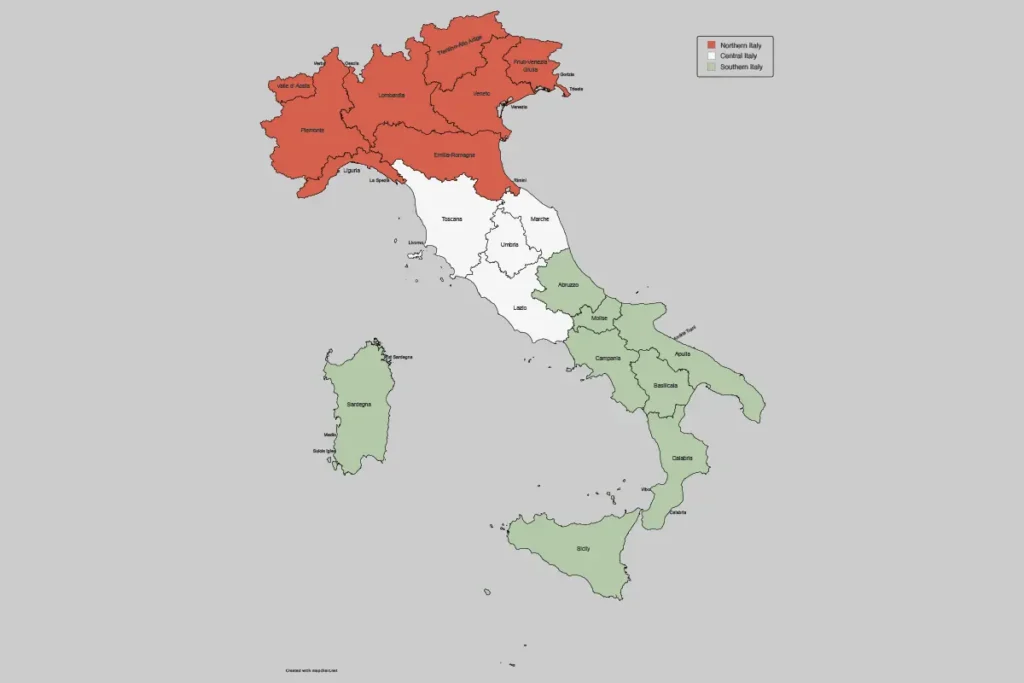
Italy is bigger and more diverse than most first-time visitors realize. You can’t “do” Italy in 10 days any more than you can “do” the United States in a week and a half. You’re choosing a region and a flavor.
Northern Italy centers on Venice, Milan, Lake Como, and the Dolomites. It’s elegant, prosperous, and architecturally distinct. The food leans toward risotto, polenta, and wine regions like Piedmont and Veneto. Northern Italy works well if you value scenery, lakes, and a more polished aesthetic.
Central Italy is what most people picture: Tuscany, Florence, Rome, and Umbria. This is Renaissance art, rolling hills, hill towns, and wine country. It’s also where you’ll find the most concentrated art history and iconic sights. Central Italy makes sense if culture and history drive your trip.
Southern Italy includes the Amalfi Coast, Sicily, Puglia, and Naples. It’s warmer, more laid-back, and feels distinctly different from the north. The food is bolder, the pace slower, and the beaches more central to daily life. Southern Italy appeals if you want coastal scenery, archaeological sites, and a grittier, less polished experience.
For 10 days, most travelers focus on one region among Italy’s destination options and maybe touch the edge of another. Rome to Florence to Venice is classic but grueling—you’re covering a lot of ground. Florence to Rome to the Amalfi Coast is more manageable. Venice to Lake Como to the Dolomites keeps you in the north without excessive train time.
Think about what matters most: art museums, coastal views, food and wine, or mountain scenery. Then choose the region that delivers.
Depth vs. Breadth: How Many Destinations Make Sense?
This is where most 10-day Italy itineraries fall apart. Five cities sounds exciting. In practice, it means you’re either constantly moving or shortchanging every place you visit.
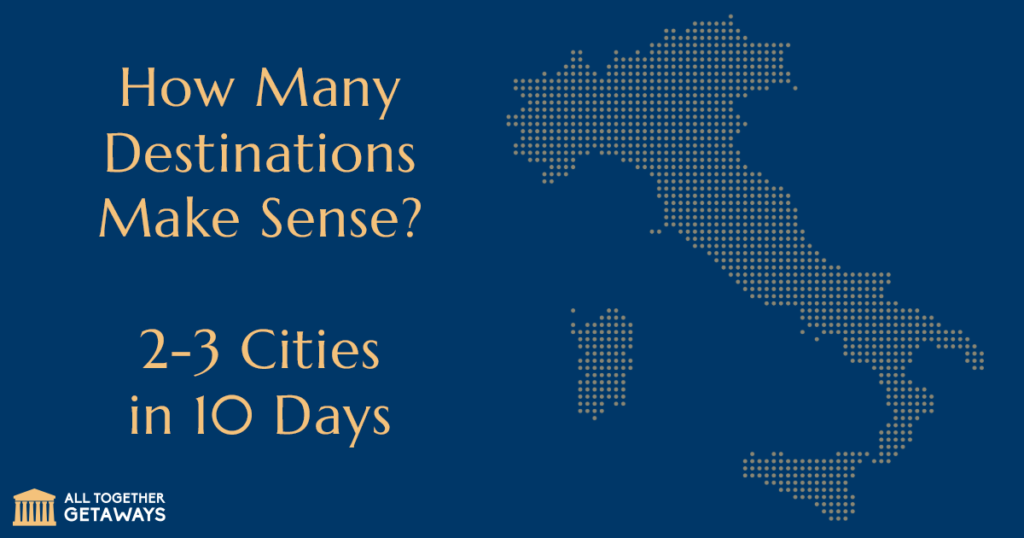
Two to three destinations is the sweet spot for 10 days. Three nights minimum per city gives you enough time to settle in, explore beyond the main sights, and recover from travel days. Four nights feels comfortable. Five or more lets you take day trips or slow down entirely.
If you try to fit Rome, Florence, Venice, the Amalfi Coast, and Cinque Terre into 10 days, you’ll spend more time packing, checking out, and sitting on trains than actually experiencing Italy. You’ll also exhaust yourself.
Here’s the math: each time you change cities, you lose half a day minimum. Packing, checking out, getting to the station, traveling, finding your next hotel, and getting oriented takes 4-6 hours even when trains run on time. Do that five times, and you’ve lost 2-3 full days to logistics.
Better approach: Pick 2-3 places and stay long enough to experience them. You can always come back to Italy. You can’t undo a trip that felt like a checklist.
What Kind of Italy Experience Do You Want?
Beyond geography, think about what you actually want to do in Italy.
Art and history focus means Florence, Rome, and possibly Venice make the most sense. You’ll spend time in museums, churches, and archaeological sites. This approach works best for travelers who genuinely enjoy walking through the Uffizi or understanding Roman history—not just checking boxes.
Food and wine focus pulls you toward Tuscany, Emilia-Romagna (Bologna, Parma, Modena), or Piedmont. You’re prioritizing cooking classes, winery visits, food tours, and meals that matter. Rome still fits here, but you’ll spend less time in museums and more in markets and restaurants.
Coastal and scenic focus means the Amalfi Coast, Cinque Terre, Sicily, or the Italian lakes. You want dramatic views, boat trips, beach time, and coastal towns. This usually means slower pacing and fewer “must-see” monuments.
Balanced approach mixes iconic sights with authentic experiences. You’ll see the Colosseum, but you’ll also take a cooking class. You’ll visit Florence’s museums, but you’ll build in a Tuscany day trip. This is the most common approach for first-timers and families.
If you’re traveling as a couple, your priorities might align easily. If you’re planning a family trip, think about what keeps both kids and adults engaged. A 10-year-old might love Pompeii but zone out after an hour in an art museum. A teenager might appreciate a gelato-making class more than another cathedral.
Map Your 10 Days: Pacing and Logistics
How Many Nights Per City?
The minimum viable stay for any Italian city is three nights. Two nights means one full day in the middle, sandwiched between partial arrival and departure days. It’s not enough.
Three nights gives you two full days plus arrival and departure half-days. Four nights is better—it lets you take a day trip or have a slower morning without feeling behind. Five or more nights means you can settle in, repeat a favorite restaurant, or skip something without guilt.
Day trips expand your range without adding hotel changes. From Florence, you can visit Siena, San Gimignano, or the Chianti wine region. From Rome, you can see Pompeii or Tivoli. From Venice, the Dolomites are reachable. Day trips work when you want to see more without the logistics of changing hotels.
One-night stays almost never make sense. The effort of packing, checking out, traveling, and checking in again isn’t worth a single night somewhere new. If a destination only merits one night, it’s probably better as a day trip—or you should skip it entirely.
Factor in Travel Days
Here’s what most online itineraries get wrong: they count every day as if it’s a full exploration day. It’s not.
Rome to Florence by train takes 90 minutes. But you’re not just on the train for 90 minutes. You’re packing, checking out, getting to Termini station, waiting for your train, riding to Florence, getting to your hotel, checking in, and getting oriented. That’s 4-5 hours minimum, and it usually eats the morning or afternoon.
Arrival and departure days are half days at best. If you fly into Rome in the morning, you’ll be at your hotel by noon if you’re lucky. You’ll be jetlagged. You might manage some sightseeing, but it won’t be a full day. Same with your last day—if you’re flying out in the evening, you’re not touring the Colosseum that morning.
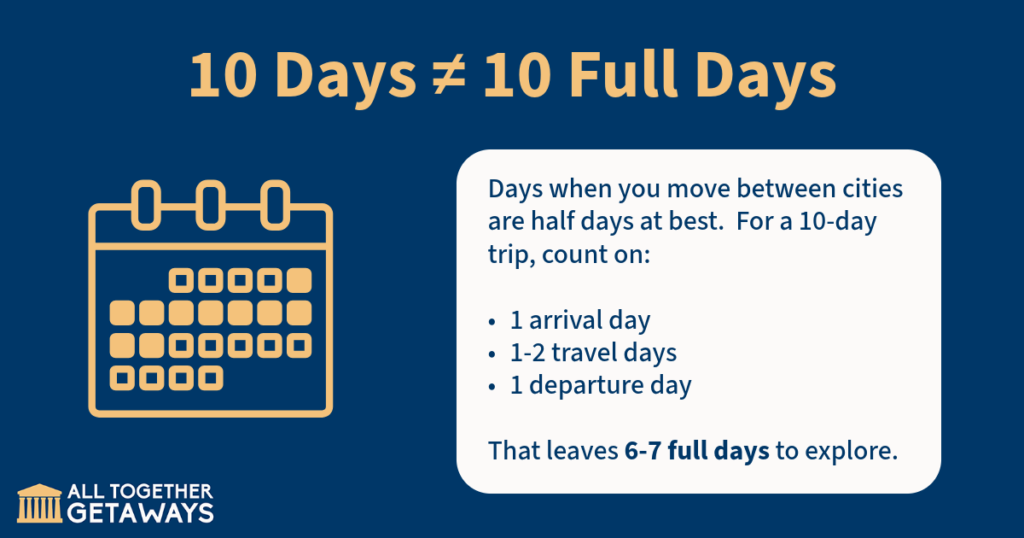
For a 10-day trip, count on:
- 1 arrival day (half day)
- 1-2 intercity travel days (half days each)
- 1 departure day (half day)
That leaves 6-7 full days for actual sightseeing and experiences. Not 10.
This is why two destinations work better than four. If you’re only changing cities once, you lose one half-day instead of three or four.
Build in Downtime
Ten full days of touring—museums, ruins, walking tours, cooking classes—will burn you out, especially if you’re traveling with kids.
Strategic rest doesn’t mean wasted time. A morning sleeping in, a long lunch, an afternoon at a park, or an evening with no plans gives you space to recharge. It also creates room for spontaneous moments: a gelato shop you stumble across, a piazza where kids can run around, a quiet hour sketching or people-watching.
For families, this matters even more. Kids don’t have the stamina for eight hours of cathedrals and museums. They need breaks, snacks, and unstructured time. A 10-day itinerary that schedules every hour will end in meltdowns—for kids and adults.
Even couples benefit from slower mornings or free afternoons. Italy isn’t a race. The best moments often happen when you’re not rushing to the next sight.
Make the Tough Calls: What to Include and Ski
The Big Three: Rome, Florence, Venice
Can you see Rome, Florence, and Venice in 10 days? Technically, yes. Should you? It depends.
This is the classic first-timer route, and it works if:
- You’re genuinely interested in art, history, and architecture
- You’re comfortable with fast pacing
- You don’t mind spending two half-days on trains
- You’re okay skipping Tuscany, the coast, and everything else
Rome deserves 4 nights if you want to see the major sites without sprinting. Florence needs 3-4 nights, especially if you’re adding a Tuscany day trip. Venice can work with 2-3 nights, though it’s one of those cities where more time reveals hidden corners.
That’s 9-11 nights just for those three cities. It’s tight but doable if you accept the pace.
If you skip one, which should it be? That depends on your interests. Rome is essential for history. Florence is the art and Renaissance capital. Venice is architecturally unique but polarizing—some people love it, others find it overrun and touristy.
If you have kids, Venice often wins because it’s walkable, visually interesting, and feels manageable. If you’re serious about art, you don’t skip Florence. If ancient history pulls you, Rome is non-negotiable.
There’s no wrong answer, but there is a wrong approach: trying to do all three plus the Amalfi Coast plus Cinque Terre. That’s when 10 days stops working.
Day Trip or Overnight Stay?
Some destinations sit between “must-see city” and “can skip.” Tuscany hill towns, the Amalfi Coast, and Cinque Terre all fall into this category.
Day trips work when:
- The destination is 1-2 hours from your base
- You’re okay with a long day (8-10 hours)
- You don’t need to see sunset or stay overnight
- You’re traveling as a couple or with older kids who can handle the pace
From Florence, Tuscany wine country and hill towns like Siena and San Gimignano make excellent day trips. From Rome, you can day-trip to Pompeii and the Amalfi Coast, though it’s a long, exhausting day.
Overnight stays work when:
- The destination feels too far for a day trip
- You want to experience the place at night or early morning
- The logistics of getting there and back in one day feel too rushed
- You’re willing to add a hotel change
The Amalfi Coast, for example, is doable as a Rome day trip—but it’s better with 2-3 nights. You’ll see Positano, Ravello, and Amalfi without the pressure of getting back to Naples to catch the last train back to Rome.
Cinque Terre can work as a day trip from Florence (it’s 2-3 hours by train), but staying overnight lets you hike between villages without rushing.
If you’re unsure, ask yourself: would I regret not staying overnight here? If the answer is yes, build in the extra night. If it’s no, the day trip probably works.
What Doesn’t Fit This Time
Here’s the hardest decision: accepting what won’t fit.
You probably can’t see northern Italy and southern Italy in 10 days. You can’t do Rome, Florence, Venice, the Amalfi Coast, Cinque Terre, and Tuscany wine country. You can’t spend four nights in each city and visit six cities.
The best 10-day Italy itineraries are focused, not comprehensive. They prioritize depth in 2-3 places over surface-level visits to six.
That means making trade-offs:
- Rome and Florence, but not Venice
- Tuscany and the Amalfi Coast, but not Sicily
- Venice and the Dolomites, but not Rome
You’re not missing out — you’re planning a second trip. Italy isn’t going anywhere, and a focused 10 days beats a scattered two weeks.
What Doesn’t Fit This Time
Here’s the hardest decision: accepting what won’t fit.
You probably can’t see northern Italy and southern Italy in 10 days. You can’t do Rome, Florence, Venice, the Amalfi Coast, Cinque Terre, and Tuscany wine country. You can’t spend four nights in each city and visit six cities.
The best 10-day Italy itineraries are focused, not comprehensive. They prioritize depth in 2-3 places over surface-level visits to six.
That means making trade-offs:
- Rome and Florence, but not Venice
- Tuscany and the Amalfi Coast, but not Sicily
- Venice and the Dolomites, but not Rome
You’re not missing out — you’re planning a second trip. Italy isn’t going anywhere, and a focused 10 days beats a scattered two weeks.
Decide How Much to Plan in Advance for Your 10-Day Italy Itinerary
What to Book Before You Go
Certain things in Italy require advance reservations, especially during peak season (May-September).
Book these ahead:
- High-demand museum tickets: The Uffizi and Accademia in Florence, the Colosseum and Vatican in Rome, and the Doge’s Palace in Venice all sell out weeks in advance during summer.
- Popular tours and experiences: Cooking classes, wine tours, and walking tours with specific guides often fill up 2-4 weeks out.
- Hotels in peak season: Florence, Rome, and Venice book solid in summer. If you want central locations or specific properties, book at least 2-3 months ahead.
- Train tickets for popular routes: You can buy Italian train tickets last-minute, but booking a few weeks out locks in better prices and guarantees seats on high-speed trains.
Don’t underestimate the value of advance planning. Showing up in Florence in July without Uffizi tickets means you’re either skipping it or standing in line for hours.
What to Leave Flexible
Not everything needs to be locked down.
Keep these flexible:
- Restaurant reservations: Outside of high-end Michelin spots, most Italian restaurants don’t require reservations more than a day or two ahead. You can decide where to eat based on your location and mood.
- Day trip decisions: If you’re unsure whether you want to visit Siena or San Gimignano from Florence, wait and see how you feel. Weather, energy levels, and what you discover in the city might shift your plans.
- Free time: Scheduling every hour creates pressure. Leave gaps for wandering, resting, or stumbling into something unexpected.
The right balance depends on your personality. If uncertainty stresses you out, book more in advance. If rigidity feels stifling, lock in the essentials and leave space for spontaneity.
DIY vs. Getting Help
Here’s where most travelers hit a wall: the logistics of Italy vacation planning start to stack up.
DIY works if:
- You enjoy researching and planning
- You have the time to compare hotels, read reviews, map routes, and book everything yourself
- You’re comfortable troubleshooting when trains are delayed or tours get canceled
- You’re okay with uncertainty about whether you chose the “right” hotels or experiences
Working with a travel advisor makes sense when:
- You don’t have time to research every detail
- You want expert guidance on which destinations make sense together
- You’d rather someone else handle logistics, bookings, and backup plans
- You value recommendations from someone who knows Italy and has vetted suppliers
I work with couples and families who want a thoughtfully planned Italy trip without spending 40 hours researching hotels and train schedules. I handle the itinerary planning, book everything, and make sure logistics flow smoothly — so you can focus on experiencing Italy instead of managing it.
Not sure if a travel advisor makes sense for your trip? I wrote a detailed breakdown of when to use a travel advisor for Italy that walks through the decision.
Sample 10-Day Italy Itineraries
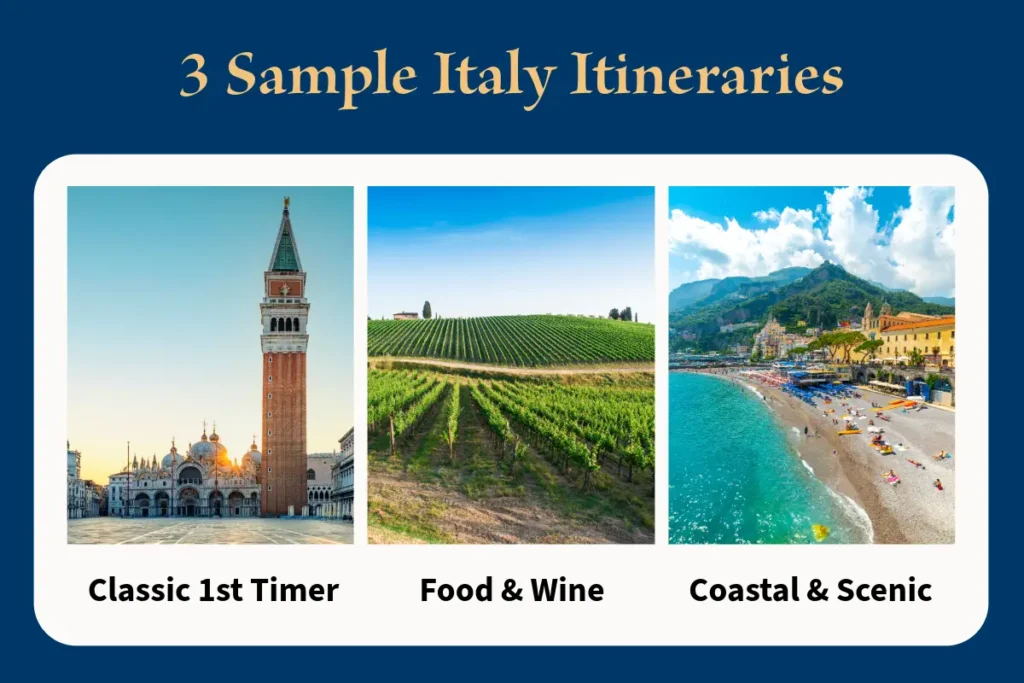
These aren’t prescriptive schedules—they’re examples of how different priorities shape different trips. Use them as starting points, not final blueprints.
Classic First-Timer: Rome, Florence, Venice
Who this works for: Couples or families visiting Italy for the first time who want to see the iconic cities and major art/history sites.
- Rome (4 nights): Colosseum, Roman Forum, Vatican Museums, Trevi Fountain, Trastevere neighborhood. Day trip to Pompeii or Tivoli if time allows.
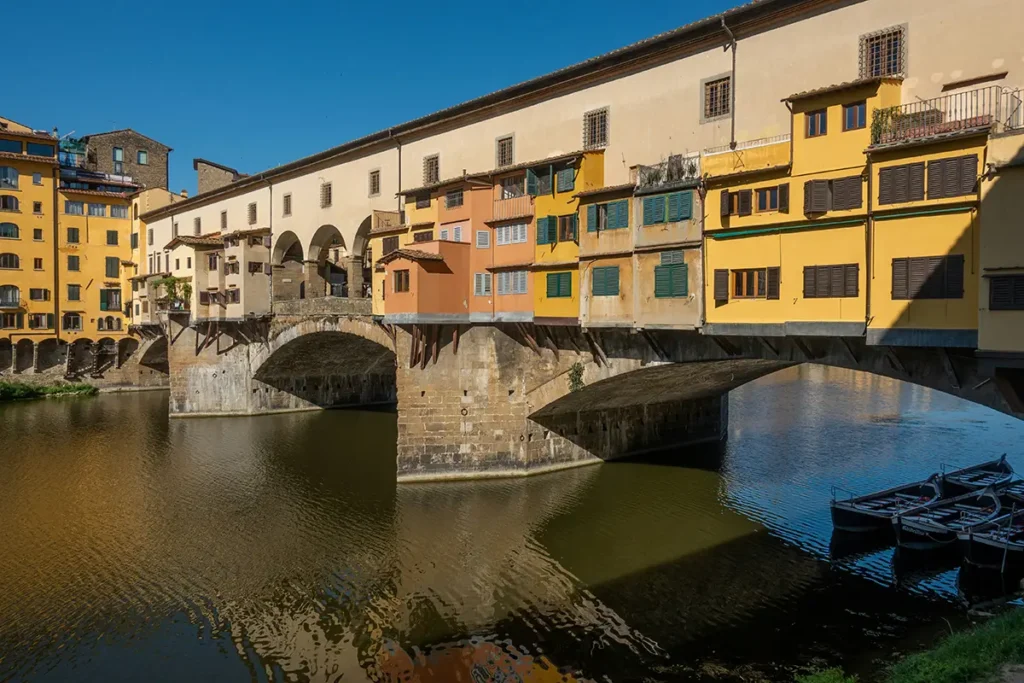
- Florence (3 nights): Uffizi, Accademia (David), Duomo, Ponte Vecchio. Day trip to Tuscany hill towns or Chianti wine region.
- Venice (2 nights): St. Mark’s Square, Doge’s Palace, Rialto Bridge, gondola ride, quieter neighborhoods like Dorsoduro.
Travel days: Rome to Florence (1.5 hours by train), Florence to Venice (2 hours by train).
This is fast-paced but manageable if you’re comfortable with movement and prioritize major sights. It’s not ideal for families with young kids or travelers who prefer slower pacing.
Food and Wine Focus: Rome, Tuscany, Bologna
Who this works for: Couples who prioritize food, wine, and culinary experiences over crowded tourist sights.
- Rome (3 nights): Trastevere food tour, Testaccio market, Jewish Ghetto restaurants. See a few key sights (Pantheon, Colosseum) but keep the focus on eating well.
- Tuscany base – Siena or Montepulciano (4 nights): Cooking class, winery visits in Chianti or Montalcino, walking medieval hill towns. Slower pace, less museum time.
- Bologna (2 nights): Pasta-making class, food market tours, traditional osterie. Optional day trip to Modena (balsamic vinegar) or Parma (Parmigiano-Reggiano and prosciutto).
Travel days: Rome to Tuscany (1.5-2 hours), Tuscany to Bologna (1-2 hours).
This itinerary skips Florence and Venice entirely, trading tourist density for food depth. It works if you’re more interested in what Italians eat than where they built churches.
Coastal and Scenic: Amalfi Coast, Rome, Florence
Who this works for: Families or couples who want a mix of culture and coastal relaxation.
- Amalfi Coast base – Sorrento or Positano (4 nights): Coastal towns (Positano, Amalfi, Ravello), boat trips to Capri, beach time, leisurely dinners. Day trip to Pompeii.
- Rome (3 nights): Major sights (Colosseum, Vatican, Trevi Fountain), Trastevere, gelato, and pizza.
- Florence (2 nights): Duomo, Uffizi or Accademia, walk across Ponte Vecchio, gelato in Piazza della Signoria.
Travel days: Amalfi Coast to Rome (train or private transfer, 2-3 hours), Rome to Florence (1.5 hours by train).
Starting with the coast lets you ease into Italy before hitting the intensity of Rome and Florence. It works well for families because the Amalfi Coast offers more downtime and visual appeal for kids.
Common Italy Vacation Planning Mistakes to Avoid
Even with a solid framework, certain mistakes trip up first-time Italy planners.
Underestimating travel time. Trains between cities are fast, but getting to and from stations, waiting, and settling into new hotels adds hours. Don’t assume a 90-minute train ride equals a 90-minute travel day.
Overpacking your days. Six museums, two neighborhoods, a cooking class, and a sunset viewpoint all in one day sounds ambitious on paper. In reality, it means rushing through everything and enjoying nothing.
Skipping smaller towns. Rome and Florence are essential, but Tuscany hill towns, coastal villages, and countryside escapes often deliver the most memorable moments. Build them in.
Not booking popular sites in advance. The Uffizi, Vatican, and Colosseum all require timed-entry tickets. Showing up without them wastes half a day or forces you to skip major sights entirely.
Trying to see everything. Ten days isn’t enough to “see Italy.” Accept that now, and you’ll plan a better trip. Focus on depth, not breadth.
10-Day Italy Itinerary FAQs

Is 10 days enough for Italy?
What's the best 10-day Italy itinerary for first-timers?
Should I visit northern or southern Italy in 10 days?
How much does a 10-day Italy trip cost?
Do I need a travel advisor to plan my Italy itinerary?
Not necessarily, but a travel advisor saves time and reduces planning stress if you don’t enjoy researching or feel overwhelmed by logistics. Advisors help with itinerary decisions, vet hotels and tours, handle bookings, and provide backup support during travel.
Can I see Rome, Florence, and Venice in 10 days?
What's the best time of year for a 10-day Italy trip?
Plan a 10-Day Italy Itinerary That Fits How You Travel
Planning a 10-day Italy itinerary isn’t about finding the “perfect” route—it’s about making decisions that match your interests, energy, and travel style.
Choose 2-3 destinations that make sense together. Factor in travel days and build in downtime. Accept that you can’t see everything, and focus on going deep instead of wide. Book high-demand experiences in advance, but leave room for flexibility.
If you’re feeling stuck on which regions to prioritize, how to pace your trip, or how to balance culture with relaxation, that’s exactly where I help. I plan custom Italy itineraries for couples and families—handling the research, bookings, and logistics so you can focus on the experience instead of the stress.
Ready to move forward? Schedule a complimentary planning call to talk through your trip. We’ll discuss your interests, timeline, and budget, and I’ll share how I can help turn your Italy plans into a thoughtfully designed itinerary.